

GCC Countries Vertical Lift Module Market Projected to Reach USD 196.7 Billion by 2036, With 7.6% CAGR | TMR
GCC Countries Vertical Lift Module Market
GCC vertical lift module market growth is driven by warehouse automation, e-commerce expansion and rising demand for high-density storage solutions.
GCC Countries Vertical Lift Module Market to Witness Consistent Growth at 7.6% CAGR from 2026–2036”
WILMINGTON, DE, UNITED STATES, February 11, 2026 /EINPresswire.com/ -- GCC Countries Vertical Lift Module Market— Transparency Market Research Inc.
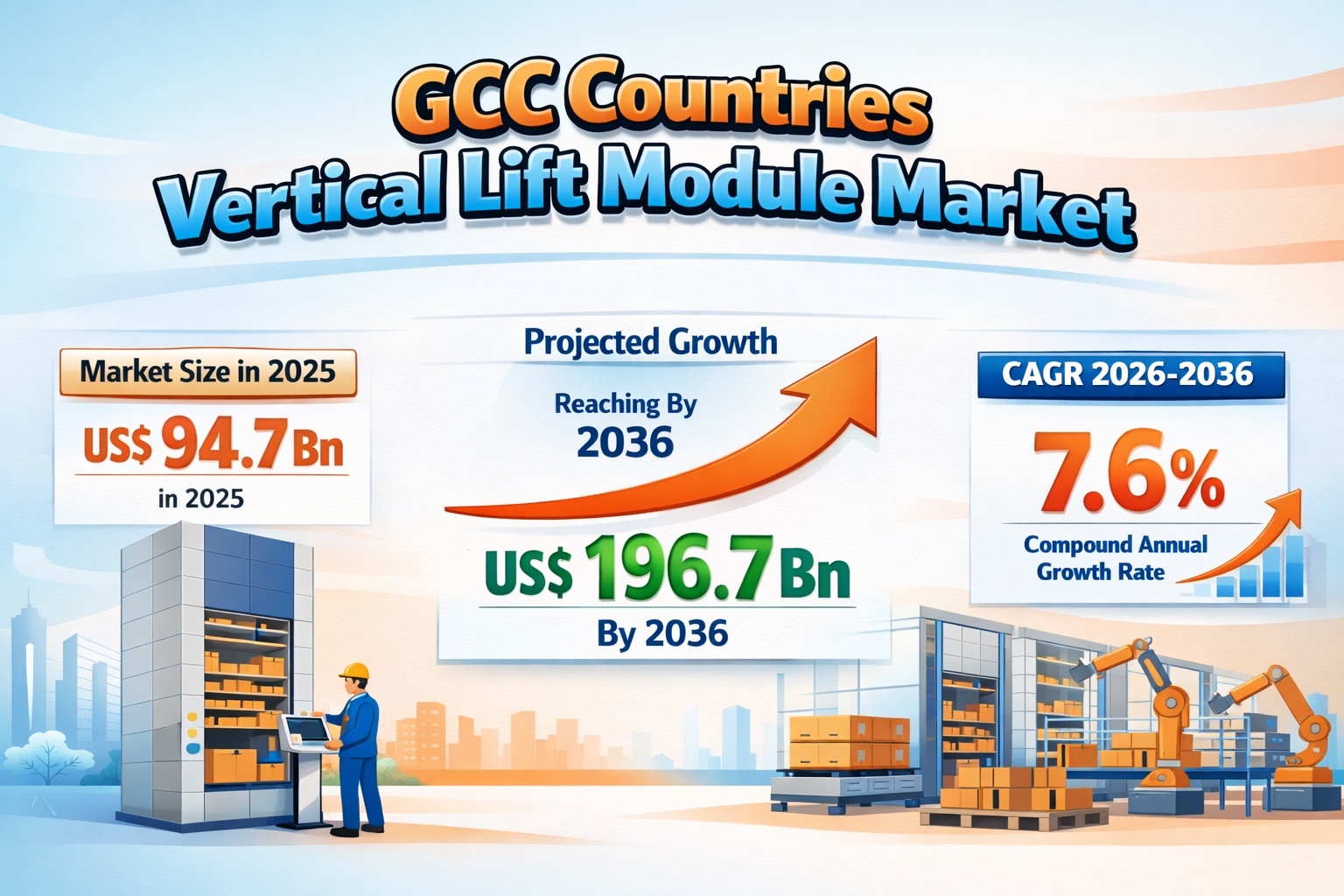
The GCC Countries Vertical Lift Module Market is witnessing substantial growth, fueled by accelerating industrial transformation and the rapid adoption of automated intralogistics solutions. The market was valued at US$ 94.7 billion in 2025 and is projected to reach US$ 196.7 billion by 2036, expanding at a compound annual growth rate (CAGR) of 7.6% between 2026 and 2036.
The steady expansion reflects growing demand for high-density storage solutions across industries such as logistics, manufacturing, pharmaceuticals, retail, and e-commerce. Increasing pressure to optimize warehouse operations and improve storage efficiency is driving the adoption of VLM systems throughout the GCC region.
Dive Deeper into Data: Get Your In-Depth Sample Now!
https://www.transparencymarketresearch.com/sample/sample.php?flag=S&rep_id=86946
Saudi Arabia emerged as the dominant regional market in 2025, capturing 42.3% of total revenue share, driven by strong investments in logistics infrastructure, industrial diversification initiatives, and rapid growth in e-commerce fulfillment centers. Additionally, the non-refrigerated VLM segment accounted for the largest market share, contributing 81.6% in 2025, due to its widespread usage in general merchandise storage and manufacturing supply chains.
Market Overview
Vertical Lift Modules (VLMs) are advanced automated storage and retrieval systems (AS/RS) that utilize vertical space to store and retrieve items efficiently. These systems consist of two vertical columns with trays and a central extractor mechanism that delivers stored items directly to an operator access point. VLMs significantly enhance inventory management, picking accuracy, operational safety, and warehouse productivity.
Across the GCC countries, including Saudi Arabia, the UAE, Qatar, Kuwait, Oman, and Bahrain, VLM adoption is accelerating due to increasing land costs, urban logistics constraints, and the need for high-speed order fulfillment. VLMs are widely deployed in manufacturing plants, distribution centers, pharmaceutical storage facilities, spare-parts warehouses, and e-commerce fulfillment hubs.
The market encompasses a comprehensive ecosystem involving hardware components such as lift modules, trays, and extraction mechanisms, along with software solutions including warehouse control systems and inventory management interfaces. Vendors are also offering integration services with Enterprise Resource Planning (ERP) and Warehouse Management Systems (WMS), enabling seamless automation and real-time inventory tracking.
The shift toward smart factories and Industry 4.0 is further driving VLM demand, as businesses aim to enhance operational efficiency, reduce labor dependency, and improve order accuracy.
Key Market Growth Drivers
Rapid Warehouse Automation across GCC
The increasing emphasis on warehouse automation is a major driver of VLM market growth. Governments and private enterprises across GCC countries are investing heavily in advanced logistics infrastructure to modernize supply chains and reduce reliance on manual labor.
Saudi Arabia’s logistics transformation initiatives under Vision 2030 and the UAE’s smart logistics corridors have accelerated warehouse modernization. These initiatives are encouraging the construction of large-scale automation-ready distribution centers and smart industrial parks.
Automation technologies such as VLMs offer measurable productivity improvements, reducing picking errors and increasing storage density. VLMs can improve picking efficiency by two to three times compared to manual shelving systems.
E-commerce Expansion Driving Fulfillment Efficiency
The rapid expansion of e-commerce in GCC countries is transforming fulfillment requirements. Growing online retail penetration, supported by high smartphone usage and a digitally connected population, is increasing demand for faster and more accurate order processing.
VLMs enable goods-to-person picking, reducing operator travel time and supporting same-day and next-day delivery models. The increasing number of localized fulfillment centers in urban areas is further strengthening demand for vertical automated storage solutions.
Infrastructure Development and Industrial Diversification
Massive infrastructure investments across GCC countries are supporting the growth of automated intralogistics systems. Mega industrial zones, bonded logistics facilities, and multimodal transportation hubs are increasingly designed with automation-friendly storage infrastructure.
Additionally, GCC governments are focusing on manufacturing diversification and local production expansion, which is increasing demand for advanced inventory storage and supply chain optimization solutions.
Growing Regulatory and Workplace Safety Requirements
Strict workplace safety and ergonomics regulations across GCC countries are encouraging organizations to adopt automated storage systems. VLMs eliminate the need for ladder usage and repetitive manual handling, reducing workplace injuries and improving operational safety.
Analysis of Key Players – Key Player Strategies
The GCC VLM market is characterized by strong competition among global automation solution providers and regional system integrators. Leading companies operating in the market include:
• Bastian Solutions, LLC
• Dematic GmbH
• Ferretto SpA
• Gonvarri Material Handling (Dexion)
• Hänel GmbH & Co. KG
• Jungheinrich AG
• Kardex Group AG
• Körber AG
• Mecalux, S.A.
• Modula S.p.A.
• SSI SCHÄFER Group
• Weland Solutions AB
• Other Key Players
Technology Innovation and Product Differentiation
Key players are focusing on developing energy-efficient, modular VLM systems with advanced software integration capabilities. Vendors are incorporating IoT-enabled predictive maintenance features to minimize downtime and improve operational performance.
Strategic Partnerships and Distribution Expansion
Companies are forming partnerships with regional distributors and system integrators to strengthen their presence across GCC markets. Expanding service networks ensures faster installation, maintenance support, and localized customer service.
Customization and Industry-Specific Solutions
Manufacturers are offering tailored VLM configurations for industries such as pharmaceuticals, aerospace, automotive, and electronics. Customized tray designs, temperature-controlled environments, and specialized software integrations are helping vendors capture niche market segments.
Explore core findings and critical insights from our Report in this sample -
https://www.transparencymarketresearch.com/sample/sample.php?flag=S&rep_id=86946
Market Challenges & Opportunities
Challenges
1. High Initial Investment Costs
The installation of VLM systems requires significant capital investment, which can deter small and medium enterprises from adopting automation solutions.
2. Integration Complexity
Integrating VLMs with existing warehouse infrastructure and IT systems can be technically challenging and time-consuming.
3. Limited Skilled Workforce
The operation and maintenance of automated storage systems require specialized technical expertise, which is currently limited in some GCC countries.
Opportunities
1. Growing Pharmaceutical Cold Storage Demand
Rising healthcare investments and increasing pharmaceutical manufacturing activities are creating strong demand for refrigerated VLM systems. Strict regulatory requirements for temperature monitoring and batch traceability further support market expansion.
2. Smart Warehousing and Industry 4.0 Adoption
The increasing adoption of digital supply chain technologies is creating significant opportunities for advanced automated storage solutions.
3. Urban Logistics Growth
The expansion of urban fulfillment centers and last-mile delivery hubs is increasing demand for space-efficient vertical storage systems.
Key Player Strategies
Leading VLM manufacturers are implementing various strategies to maintain competitive advantage:
• Launching AI-driven warehouse automation platforms
• Expanding service and support infrastructure in GCC countries
• Investing in research and development for energy-efficient storage solutions
• Strengthening partnerships with local distributors and integrators
• Offering flexible financing and leasing options to increase customer adoption
• Enhancing software integration capabilities with ERP and WMS platforms
Recent Developments
In March 2025, Kardex has launched an upgraded Vertical Lift Module (VLM) with its new Total Intelligence Concept (TIC) control system, featuring an intuitive, multilingual 12.1-inch touch interface to boost usability and efficiency. The scalable, ergonomic solution accelerates order fulfillment, reduces errors and downtime, and enhances connectivity, helping companies streamline storage operations and cut costs as demand for automated intralogistics grows.
In June 2025, Dexion Gonvarri Material Handling announced that Musaed Bader Al-Sayer & Sons Company (MBS), its long-standing distributor in Kuwait, had expanded operations to the United Arab Emirates. MBS UAE became the exclusive distributor for Dexion GMH in the country, strengthening regional reach.
In June 2025, Coop Group and SSI SCHAEFER deepened their long-term partnership by launching a large-scale upgrade of the WAMAS intralogistics software. The rollout spans all 60 Coop warehouses across Switzerland, Germany, Poland, and Romania, enhancing transparency, automation, and operational efficiency as part of a multi-year digital modernization program supporting scalable growth and resilience.
Investment Landscape and ROI Outlook
The GCC VLM market presents strong investment opportunities due to its alignment with government-led logistics modernization initiatives and industrial diversification strategies. Increasing warehouse construction projects and rising e-commerce penetration are generating consistent demand for automated storage solutions.
VLM systems offer significant return on investment through improved storage density, reduced labor costs, enhanced picking accuracy, and faster order fulfillment. Businesses implementing VLM technology typically experience productivity improvements of up to 300%, along with reductions in warehouse footprint and operational costs.
Furthermore, predictive maintenance features and energy-efficient designs are reducing long-term operating expenses, making VLM solutions financially attractive for both large enterprises and mid-sized logistics providers.
Buy this Premium Research Report for key findings and thorough analysis –
https://www.transparencymarketresearch.com/checkout.php?rep_id=86946<ype=S
Market Segmentations
By Type
• Non-Refrigerated
• Refrigerated
By Orientation
• Internal Bay
• External Bay
By Configuration
• Single Bay
• Dual Bay
By Maximum Load Capacity
• Below 20 Tons
• 20 Tons to 40 Tons
• Above 40 Tons
By Height
• Up to 7 Meters
• 7 to 15 Meters
• Above 15 Meters
By End-use Industry
• Metals & Machinery
• Automotive
• Food & Beverages
• Electronics
• Logistics
• Healthcare & Pharmaceutical
• Retail
• Others
By Distribution Channel
• Direct Sales
• Indirect Sales
By Region
• UAE (United Arab Emirates)
• Saudi Arabia
• Qatar
• Kuwait
• Oman
• Bahrain
Why Buy This Report?
• Comprehensive analysis of GCC VLM market trends and growth forecasts
• Detailed segmentation insights across multiple industry verticals
• Competitive landscape and company benchmarking analysis
• Evaluation of market drivers, restraints, and opportunities
• Strategic insights into warehouse automation and smart logistics adoption
• In-depth regional analysis covering key GCC countries
• Investment outlook and ROI assessment for automation technologies
FAQs
1. What is driving the growth of the GCC Vertical Lift Module Market?
The market growth is primarily driven by warehouse automation adoption, rapid e-commerce expansion, infrastructure development, and increasing demand for high-density storage solutions.
2. Which country leads the GCC VLM market?
Saudi Arabia leads the market, accounting for over 42% of total revenue share due to strong logistics infrastructure investments and industrial diversification initiatives.
3. Which segment dominates the market by type?
The non-refrigerated segment dominates the market due to its widespread application in retail, manufacturing, automotive, and e-commerce industries.
4. What industries are major end-users of VLM systems?
Key end-users include logistics, automotive, electronics, healthcare, pharmaceuticals, manufacturing, and retail sectors.
5. What future opportunities exist in the GCC VLM market?
Significant opportunities are emerging in pharmaceutical cold storage automation, smart warehousing, Industry 4.0 adoption, and urban logistics infrastructure development.
More Related Reports -
• Low & Medium Voltage Motors Market - https://www.transparencymarketresearch.com/low-medium-voltage-motors.html
• Rolled Steel Motors Market - https://www.transparencymarketresearch.com/rolled-steel-motors-market.html
• Precision Electric Motors Market - https://www.transparencymarketresearch.com/precision-electric-motors-market.html
• Motor Soft Starter Market - https://www.transparencymarketresearch.com/motor-soft-starter-market.html
About Us Transparency Market Research
Transparency Market Research, a global market research company registered at Wilmington, Delaware, United States, provides custom research and consulting services. The firm scrutinizes factors shaping the dynamics of demand in various markets. The insights and perspectives on the markets evaluate opportunities in various segments. The opportunities in the segments based on source, application, demographics, sales channel, and end-use are analysed, which will determine growth in the markets over the next decade.
Our exclusive blend of quantitative forecasting and trends analysis provides forward-looking insights for thousands of decision-makers, made possible by experienced teams of Analysts, Researchers, and Consultants. The proprietary data sources and various tools & techniques we use always reflect the latest trends and information. With a broad research and analysis capability, Transparency Market Research employs rigorous primary and secondary research techniques in all of its business reports.
Contact Us
Transparency Market Research Inc.
CORPORATE HEADQUARTER DOWNTOWN,
1000 N. West Street,
Suite 1200, Wilmington, Delaware 19801 USA
Tel: +1-518-618-1030
USA - Canada Toll Free: 866-552-3453
Abhishek Budholiya - Marketing Team
Transparency Market Research Inc.
+1 518-618-1030
email us here
Legal Disclaimer:
EIN Presswire provides this news content "as is" without warranty of any kind. We do not accept any responsibility or liability for the accuracy, content, images, videos, licenses, completeness, legality, or reliability of the information contained in this article. If you have any complaints or copyright issues related to this article, kindly contact the author above.
